Vermont – Of Maple Creemees and Lake Monsters

IMG_7895
Lake Champlain ferry makes the turn past the lighthouse at the downtown Burlington VT waterfront.

I recently returned from a weeklong trip to the state of Vermont. I had been to Vermont once before, about five years ago. This year I returned, to visit and learn more about the Green Mountain state.

Flying up on a Wednesday, I arrived early enough to catch a Vermont Lake Monsters game. The Vermont Lake Monsters are the Short Season-A affiliate of the Oakland Athletics and a member of the NY-Penn League. The Lake Monsters play in Historic Centennial Field, located on the campus of the University of Vermont in Burlington. The playing field is said to date from 1906, with the grandstand first being built in 1922. The grandstand has been renovated over the years, and visiting a group area down the right field line requires a fan to walk past the home team clubhouse and batting cage. This provides prime areas for young fans to greet the players and ask for autographs. The young fans also enjoy the team mascot Champ, a lake monster who crawled out of nearby Lake Champlain back in 2005. Wednesday night’s game saw the Lake Monsters defeat the visiting Lowell Spinners 7-4. I watched three more games during my trip. Thursday saw Lowell defeat Vermont 2-1. Saturday night Vermont blew a three-run lead and lost 8-6 to the visiting Connecticut Tigers. Sunday night was a marathon, with Vermont defeating Connecticut 6-5 in 13 innings (I gave up after ten full innings). The crowds grew in size as the week progressed, from 1,400 on Wednesday to 3,500 on Sunday. The Lake Monsters are the only minor league team in Vermont – there are a few summer league teams, but the University of Vermont dropped baseball as a sport back in 2009.

Thursday I drove over to Montpelier, the smallest of the 50 state capitals. The Vermont State House is elegant, with a golden dome visible as one drives into town. I visited the legislative chambers and the Governor’s ceremonial room. The Vermont legislature is not very big, with just 30 state senators.

Thursday afternoon I drove down to Plymouth Notch, to see the President Calvin Coolidge State Historic Site. The town of Plymouth Notch has been largely preserved as a memorial to President Coolidge, who died within five years of leaving office. The Coolidge homestead has restored the living room to how it would have appeared in 1923, when Colonel Coolidge administered the Presidential oath of office to his son. Other buildings in town are restored to resemble when Coolidge visited during his Presidency. Little of Coolidge’s presidency is mentioned in Plymouth Notch, as the Coolidge Library and Museum are located in Northampton, Massachusetts, where Coolidge spent most of his adult life.

Friday morning I stopped in for a haircut at Garry’s Barber Shop in Essex Junction. The shop has a smaller storefront, but is deep enough to hold six barber stations behind the front counter. The seven chairs for waiting customers fit in just inside the door. Around the shop are shelves of hair products for sale. Also for sale? Vermont maple syrup, available by the gallon or whatever quantity you wish.

Friday I did a food exploration around Waterbury Center. First I stopped at the Cabot Annex store, to enjoy samples of 15-20 different brands of cheese. Then I drove north to the Cold Hollow Cider Mill for apple cider and a cider doughnut. After I ate barbecue in Waterbury, I drove back north to enjoy ice cream at the Ben and Jerry’s Farm. I wasn’t able to see them make the cheese (which happens in the town of Cabot northeast of Montpelier) or squeeze the cider (it is out of season). All were delicious, though. And worth a return trip someday…

Saturday morning I drove up to the Lake Champlain Islands. I followed US 2 out of Colchester and across to South Hero and then North Hero. I stopped in North Hero at Hero’s Welcome, a general store/gas station/marina/café/post office/everything. I ate lunch while overlooking the small marina, enjoying the breeze and the French chatter coming from a group of bikers from Quebec.

Saturday afternoon I found the President Chester Arthur State Historic Site near Fairfield. It is located about 12 miles from St. Albans City on back roads. The site is a reconstruction of the parsonage where President Arthur lived in the 1830s. The original building was not preserved for a number of reasons, including the far-fetched idea of Chet Arthur growing up to be President. There is little to celebrate Arthur’s life, mainly a few panels and no artifacts. The museum is an example of how much people remember his presidency (1881-85). The site interpreter was very knowledgeable, making the visit well worth the drive.

Sunday I traveled east in search of maple sugar/syrup. I stopped at two sugarhouses – Morse Farm Maple Sugarhouse near Montpelier and Bragg Farm Sugarhouse near East Montpelier. In addition to seeing the sugar-making equipment and the modern sap lines running through the woods, I was able to sample maple-flavored foods. My favorite discovery? Maple creemees, which are best described as maple-flavored soft-serve ice cream. I made sure to each a maple creemee at each sugarhouse.

Monday was spent on the downtown Burlington waterfront. I watched the lake ferries and private boats come into and out of the harbor. Tuesday I flew home.


My 50 State Project (and number of states in which I have done each):
– Haircut (44) – Garry’s Barber Shop, Essex Junction
– State Capitol (41)
– Church (43) – Barre Congregational Church, Barre
– Movie (41) – “Dunkirk,” Majestic 10 Cinemas, Williston
– Barbecue (43) – Prohibition Pig, Waterbury
– Baseball (38) – Vermont Lake Monsters
– Community College (46) – Community College of Vermont, Winooski
– Complete State Sets (34) – Vermont

IMG_7599
Historic Centennial Field, Burlington, VT

Utah! Arches, Canyons, and the Great Salt Lake

IMG_7298
The Green River in Canyonlands National Park, from the Green River Overlook.

(A recap of my trip over Memorial Day 2017.)

At the end of May 2017 I took a trip to the West, visiting Utah and Colorado. My goal was to attend the Junior College World Series in Grand Junction, Colorado. But first I decided to fly into Salt Lake City and drive to Grand Junction, traveling through parts of Utah I had yet to visit.

The details from the Utah!* portion of my trip: (*exclamation point sponsored by the Utah Department of Tourism)

After arriving in Salt Lake City on Wednesday morning, I drove east to visit the Utah State Capitol. The Capitol itself is on a high hill overlooking downtown Salt Lake City. I found it amazingly accessible, with no security screening and with multiple entrances open. The Utah State Capitol does not have much in the way of statuary: it has a monument honoring the Mormon Battalion that served in the Mexican War, and a statue of Brigham Young (who served as a territorial governor). I visited the legislative chambers and other public areas of the Capitol.

After a brief walk through nearby Temple Square, I drove west along Interstate 80 to visit the Great Salt Lake. I stopped at the Great Salt Lake State Park and Marina and walked along the shore. I had wanted to visit the Great Salt Lake, intrigued by how salty a self-contained lake (with no outlets) would feel. I stuck my left hand in the lake, the saltiness evident to the touch. There is also an odor I could not identify. It wasn’t from decaying plants or animals, as nothing substantial lives in the lake.

I spent Wednesday night in Orem. I watched “Smokey and the Bandit” on the big screen at Cinemark University Mall 14. It was not a limited theatrical release, but rather a special presentation available to DishNetwork subscribers. Initially the theatre couldn’t find the right channel, which caused us to start heckling. Eventually they found the presentation and fast-forwarded through the preview, a trait the guy behind me wishes the theatre would extend to all their movies.

Thursday morning I had my hair cut at Lou’s Barber Shop in Payson, located a few miles south of the I-15/US6 interchange. Lou’s is a three-chair barber shop owned by Lou and his wife. It celebrates World War II-era aircraft and also celebrates Utah colleges with pennants.

If you are traveling from Salt Lake City to south-central Utah, you have two options – driving down I-15 to its junction with I-70 and then east (5 hrs to Green River) or driving on US6 over the top of the mountains (4 hrs to Green River). I chose US6, a major highway without medians and sometimes only two lanes. It provides some gorgeous scenery, but also some challenging driving.

The first town on the other side of the mountains is Helper (named for the helper locomotives that once helped on the railroad over the mountains). I stopped for lunch and to visit the town’s Western Mining and Railroad Museum. Another hour’s drive through empty countryside puts you in Green River, home of the John Wesley Powell River History Museum. The Museum celebrates the location as the most accessible place for pioneers to ford the Green River, as well as Powell’s 1869 and later expeditions to explore the Green and Colorado Rivers.

Friday I visited the two National Parks near Moab. I first visited Arches National Park. I stopped at the Park Avenue formations and hiked to see the North and South Windows, the Turret Arch, and the Double Arch. You can hike up to the arches, an opportunity I took with the North and South Windows. I am scared of heights just enough to discourage me from climbing into the Double Arch beyond the trail. I found myself enjoying the scenic views of the arches, which seemed placed at random on top of the plateau.

I spent Friday afternoon in Canyonlands. I found it more expansive, both in size and in the smaller crowds. Of particular interest to me were the views of the Green River, carved into the rocks miles away from any trail (but which seemed to be right in front of you). I lingered at both Shafer Canyon and the Green River Overlook as long as I could.

Saturday I drove from Moab to Grand Junction, Colorado. Unlike US6, this stretch of Interstate 70 does not offer much in the way of inspiring scenery or challenging driving. The most challenging part of the drive? Trying to make it 60 miles between services for drivers.

Saturday through Monday I attended the Junior College World Series. (See separate blog post). I drove back Tuesday along the same route. When I returned to Salt Lake City Tuesday, I visited the campuses of Utah Valley University and the University of Utah. I flew home Wednesday morning.

My 50 State Scorecard (and the number of states in which I have done each):

Haircut (43): Lou’s Barber Shop, Payson, UT
State Capitol (40): Utah
Movie (40): Smokey and the Bandit, Cinemark University Mall 14, Orem
Barbecue (41): The Blu Pig, Moab
Community College (45): Salt Lake Community College
Complete State Sets (33): Utah
(I had watched Baseball and attended Church services on a trip to Utah around Labor Day 2013.)

IMG_7237
Park Avenue in Arches National Park, Utah
IMG_7269
Double Arch, Arches National Park, UT
IMG_7177
The Great Salt Lake, at a low water level, Great Lake State Park and Marina, near Magna, UT

Haircut at a Tonsorial Parlor

nc-c-foy-tonsorial-parlor-new-bern-1
The C. Foy Tonsorial Parlor is located in the Kress Mall in downtown New Bern, NC.

Another type of barber shop experience can be had by patronizing a Tonsorial Parlor. A tonsorial parlor specializes in all manner of hair care services for the customers, including: haircuts; straight-razor shaves; neck, scalp, and shoulder massages. The C. Foy Tonsorial Parlor is located in New Bern, the county seat of Craven County in eastern North Carolina. The Parlor is a barber studio inside an older street mall. Inside the front door is a desk with a receptionist, similar to what you might see in an office. The shoe shine stand is inside the front window with a few chairs around it. In the middle of the floor is a small waiting area with four upholstered chairs for waiting customers. In the back of the shop, under the balcony, are two barber stations plus a third one set up for washing and shampooing hair. The stations are filled with tools and materials. My barber Eric (a master barber) is a retired Marine originally from Roxboro. He spoke of his military service and living in Okinawa when it was hit by a typhoon. He also asked me the typical biographic questions. Eric was methodical and meticulous, taking a full hour to get it just right and asking my feedback throughout. After finishing the haircut, he shaved my neck with a razor and gave me a scalp massage. While I was getting my haircut, others were continually sweeping up the loose hair and brushing the hair off customers after their cuts were completed. I paid $40, plus a tip, for the experience. I enjoyed patronizing a tonsorial parlor, but I don’t think I could afford to frequent one very often.

Kansas, Tallgrass Prairie

IMG_6031
Tallgrass Prairie National Preserve near Strong City, Kansas

(A trip to Kansas in August 2016)

In mid-August I took a week-long trip to Kansas. I had been in Kansas once before, for a few hours in November 1994 as part of a high school trip. (We toured the now-relocated Olathe Boot Company.)

I started my trip on a Saturday afternoon. After flying in Wichita, I drove north to Abilene. Abilene is the hometown of President Dwight D. Eisenhower, celebrated by a Presidential Library, Museum, and Boyhood Home. The Boyhood Home remains in its original location. Construction began on the Library and Museum shortly after Eisenhower was elected (in contrast to recent presidents, whose libraries are finished years after they leave office). For much of the Museum, he is General Eisenhower and the final portion is dedicated to his presidency. Much of the museum is dedicated to the victorious Allied forces in World War II. Saturday night I patronized a restaurant that was once a favorite of the General. The Dickinson County Museum across the street does not include much about Eisenhower, but does include the Museum of Independent Telephony, a shrine to locally manufactured phones. (The company known as United Telecom started in Abilene.)

After a full 24 hours in Abilene, I traveled to Topeka Sunday afternoon. The Kansas State Capitol’s exterior reminded me a little of other Plains states capitols I have visited. On Monday morning I was able to walk around the House chamber and climbed the Speaker’s dais. I learned of the 1893 Legislative War between the Republicans and Populists, a disputed election that resulted in the Republicans breaking down the doors to seize power.

The Brown v. Board of Education National Historic Site is located southeast of the State Capitol, in the old Monroe School. The first floor of the building covers not just the five school segregation cases that made up the Brown v. Board of Education decision, but covered the civil rights movements as well. The Topeka case was the first alphabetically, giving Topeka a place in history. (Kansas schools in 1953 were permitted to be segregated in elementary school, but integrated in high school. A product of the paternalistic racism present at statehood.)

Taking US40 east, I stopped on the campus of the University of Kansas in Lawrence. The Robert J. Dole Institute of Politics includes a museum celebrating the former US Senator and 1996 presidential candidate. I also took advantage of season-ticketholder seat selection to visit the interior of Allen Fieldhouse and see the basketball court.

For lunch Monday I stopped at Joe’s Kansas City Bar-B-Que in Olathe. Formerly known as Oklahoma Joe’s, the restaurant has garnered national attention by journalists and barbecue enthusiasts. The Olathe location was the second one, opening in 2005. I enjoyed a Kansas City-style brisket sandwich and potato salad.

Tuesday morning I drove to the Tallgrass Prairie National Preserve, near Strong City. The preserve is owned by the Nature Conservancy and operated in partnership with the National Park Service. It includes the largest preserved remnant of the tallgrass prairie that was once so plentiful across the Great Plains. One can hike to one’s content all over the preserve (a former ranch), but visitors were warned that the bison on the preserve had recently become more aggressive towards tourists and that one should keep at least a 125-yard distance. I didn’t see any, but I did see plenty of grass.

From Strong City I drove Kansas 177 south to El Dorado, through privately owned grasslands. I stopped in Cottonwood Falls and in El Dorado. I visited the Kansas Oil Museum, which celebrates the oil boom of Butler County, Kansas.

Tuesday night was my first trip to Lawrence-Dumont Stadium near downtown Wichita. The stadium, built in 1954, with only cosmetic changes recently (new bucket seats in the grandstands). The main tenant is the National Baseball Congress, with displays in the main concourse and past the outfield fence. The stadium is marked by an iconic bat sculpture in the right field corner. I arrived too late for the NBC, but managed to watch four games of the Wichita Wingnuts, a team in the independent American Association of Professional Baseball. Wichita split a doubleheader with the Kansas City T-Bones on Tuesday, before winning the final two games of the series Wednesday and Thursday.

Wednesday I visited the campus of Wichita State University. And then I headed northwest to Hutchinson. I visited Strataca, the Kansas Underground Salt Museum. Visitors first take an elevator ride down 650 feet to the mine below. The mine displays and gift store are all located underground. The mine tunnels are about 11-12 feet high and very stable. Exhausted portions of the mine are now used for underground data and artifact storage. I took the “Dark Tour” through the mine. In addition to explaining how the mining was conducted and other environmental features of the mine, visitors were allowed to pick a few souvenir salt crystals from a pile. The tour was worth the free salt.

I spent Thursday around Wichita, including visiting the Keeper of the Plains sculpture in the Arkansas River downtown. I flew home Friday, despite some weather delays in Chicago.

The scorecard for My 50 State Project (and the number of states in which I have done each):

Haircut (42): West Central Barber Shop, El Dorado
Capitol (39)
Church (41): Abilene Brethren in Christ Church
Movie (39): “Central Intelligence,” Palace Theatres, Wichita
Barbecue (39): Joe’s Kansas City Bar-B-Que, Olathe
Baseball (36): Wichita Wingnuts
Community College (43): Cloud County Community College, Junction City
Complete State Sets (32): Kansas

IMG_5866
General Eisenhower at the Eisenhower Presidential Library and Museum, Abilene, KS

IMG_6055

Haircut in a Grocery Store

Coachlite Cutters I on second floor of Meijer in Portage, MI. October 10, 2015.

Another unique place to get a haircut is at a grocery store. My brother found a barber shop located on the second floor of a Meijer located in Portage, Michigan. You enter through the regular front doors and then ascend a staircase near the customer service area. There is a barber pole located outside the enclosed shop, located between an employee lounge and a conference room. The shop has a salon-type atmosphere, as Paul Mitchell pictures hang on the walls and Paul Mitchell hair products are for sale inside. The inside also contains wallpaper with random barber shop pictures. There are seven black salon chairs and seven seats for waiting customers, with a low counter between the barber chairs and the waiting area (which contains the usual refreshments). In the middle of shop floor (between the four chairs on the right and three on the left) are displays of hair products. There were six barbers – five female and one male – working Saturday morning. Most conversations were between the barber and the customer in the chair. My barber was Lance. In addition to the usual biographical questions, he mentioned that he had once worked as a bartender and is taking his daughter to her first rock concert in the upcoming weeks. I paid $16, plus a tip, for the haircut. In general, Coachlite Cutters I (there is another location in another Meijer in town) felt like a typical salon-type barber shop, albeit it one where you can see acres of merchandise for sale one floor below.

My Maine Adventures

Otter Point in Acadia National Park, Maine

(my trip to Maine in early September 2015)

A few weeks ago I took a trip to the great state of Maine. I had visited Maine for about a half-hour back in 2012, stopping in Kittery just inside the state’s borders. Three years later, I returned to experience the state.

After flying into Portland on Saturday, I drove up to Brunswick. My first stop was to fulfill a life goal of mine – eating a Maine lobster while in Maine. The Historic Brunswick Diner advertises itself as having “the Best Lobster Roll in Maine.” It was delicious. For dinner Sunday, I enjoyed a hard-shell lobster at the Muscongus Bay Lobster Company near Round Pond, across the dock from the Round Pond Lobster Co-Op. It took a bit of work, but was well worth it.

I spent Sunday along the coast east of Brunswick. I visited the Maine Maritime Museum in Bath, a former shipyard converted to explain the methods used and the people who built the ships. It also includes an exhibit on lobstering, complete with traps, boats, and buoys. I also visited the Pemaquid Point Lighthouse Park. I climbed to the top of the famous lighthouse (pictured on the back of the Maine quarter) and visited the Fishermen’s Museum next door. I ventured down onto the rocks, going as close as I dared to the tidal waves.

Monday I traveled from Maine into New Hampshire, to visit a few places I missed during my earlier visit. I stopped in Wolfeboro and ate lunch on the banks of Lake Winnipesaukee. I also visited the New Hampshire Boat Museum and the Wright Museum of World War II while in Wolfeboro. I stayed overnight Monday in Manchester, where I caught a New Hampshire Fisher Cats game on Monday evening. The stadium had a few quirks, most notably the main entrance being in left field, downstairs from the seating bowl. The main scoreboard was next to the left field foul pole, which was hard to see from where I sat on the third base side. The Fisher Cats trailed for most of the game before gaining a 6-4 lead in the bottom of the eighth. They promptly blew the lead by giving up five runs in the top of the ninth to the visiting Portland Sea Dogs, losing 9-6.

Tuesday morning I found the authentic New Hampshire diner I was searching for on my earlier trip. The Trackside Café in Exeter is located in the back of Gerry’s Variety Store, next to the train station. As you turn the corner past the canned foods you arrive at the front counter of the diner. All the locals were there and welcomed me as I ate my Western Omelet and home fries. I visited the American Independence Museum in Exeter, celebrating the town’s turn as colonial wartime capital and the famous citizens it contributed to the American cause. From Exeter, I traveled north to Durham, where I visited the campus of the University of New Hampshire and ate at the UNH Dairy Bar located at the Durham train station.

Tuesday afternoon I was in Augusta, Maine. I visited the Maine State House. I was not able to access either of the visitors galleries, and the Governor does not have a formal reception room. But I was able to wander all through the Senate chamber and was able to sit on the third floor porch overlooking nearby Capitol Park. I spent 45 minutes quick minutes visiting the next-door Maine State Museum, which celebrates the state’s various industries (including ice harvesting).

Wednesday I traveled first to downtown Orono, where I had my hair cut at Dick’s Barber Shop. Dick was a great conversationalist, talking about his history of the shop (he had bought it in 1988 and still opens at 6AM as the previous owner had) and his travels.

Wednesday afternoon I visited Acadia National Park on Mount Desert Island near Bar Harbor. I first visited the top of Cadillac Mountain, the highest point on the island, and offering panoramic views of the island and the sea around it. I also visited the shores of Sand Beach and enjoy the waves against Otter Point. I could have spent the entire day enjoying Acadia.

Thursday I went into the woods “deliberately,” to borrow a phrase from Thoreau. The Maine Forest and Logging Museum near Bradley is located a couple miles back on the gravel Government Road. It is an off-the-grid museum that celebrates process of lumbering and building things. It also celebrates the outdoor life, including an alewives’ fishway around a beautiful waterfall.

Thursday afternoon I traveled up to Millinocket. Millinocket is the town closest to the northern terminus of the Appalachian Trail. The town has an “edge of the frontier” feel to it, as it caters to nearby Baxter State Park and Mount Katahdin. Although I’ve only hiked a mile of the AT (near Roanoke, VA), I did enjoy the Appalachian Trail Café and upstairs gift store that celebrates the hikers’ accomplishments. I have had a fascination with Millinocket, maybe because the next town due north is in Canada, separated by miles of the Maine North Woods. Or maybe because I enjoy saying the name Millinocket.

Friday I began my drive back to Portland. I stopped at the Cole Land Transportation Museum on the southern edge of Bangor. The museum is Mr. Cole’s collection of all manner of conveyances, from railroads to commercial and military trucks to snowplows and automobiles, even bicycles and sleds. I drove down US 202 to Unity, Maine, where I ate lunch and walked around the campus of Unity College (“The Environmental College”), where I did not easily blend into the small student body.

Friday and Saturday nights I attended Portland Sea Dogs games. The Sea Dogs play in Hadlock Field, the most architecturally diverse stadium I have visited. Hadlock Field appears to be built into a small space. There is a nearby arena that juts into the stadium, standing about ten yards off the right-field foul line. The home bullpen is located upstairs in right-center field. And my seat was so close to the action that I felt like I was sitting in the third-base coach’s box. All the stadium’s quirks combine to endear itself to you, and many fans love it. (I might have enjoyed more space, particularly in the mid-level concourse between seating areas.) Friday night’s game was a pitcher’s duel won by the New Britain Rock Cats 3-0. Saturday night’s game saw far more offense, as New Britain won that game 11-9.

I spent Saturday winding down. I rode the Maine Narrow Gauge Railroad along the Portland waterfront (the narrow gauge is 2′ apart). I also enjoyed a fried haddock sandwich and seeing the boats on the water. Sunday morning I flew home.

My Official State Scorecard (and the number of states where I have done each):

Haircut (41): Dick’s Barber Shop, Orono
State Capitol (37)
Church (39): Phippsburg Congregational Church, founded in 1765 and current building built in 1802. It had boxed-off wooden pews and great acoustics.
Movie (37): “No Escape,” Bangor Mall Cinemas 10
Barbecue (37): Mainely Meat Bar-B-Que, Bar Harbor
Baseball (32,33): New Hampshire Fisher Cats, Manchester; Portland Sea Dogs, ME.
Community College (41): Eastern Maine Community College, Bangor.
Complete State Sets (28, 29): New Hampshire, Maine.

Pemaquid Point from the top of the Lighthouse. Despite being more "stout" than I once was, I made it to the top.
Pemaquid Point from the top of the Lighthouse. Despite being more “stout” than I once was, I made it to the top.
In the woods deliberately. A lake just east of Millinocket, ME.

Atop a Lonely, Lonesome Highway West of Omaha

The view of Interstate 80 from the Great Platte River Road Archway near Kearney, Nebraska

(My trip to Nebraska in June 2015, with title inspired by Bob Seeger)

In mid-June 2015, I visited Nebraska, the last of the Lower 48 states I have visited. It was a baseball-centric trip, as I attended five baseball games in total – one with the Lincoln SaltDogs, the first three games of the College World Series, and a Monday night Omaha Storm Chasers game. Around those baseball adventures, I managed to have some additional adventures.

On Wednesday June 10, I flew to Eppley Airfield in Omaha. After picking up the rental car, I drove an hour to Lincoln. That night I watched the Lincoln SaltDogs defeat the Winnipeg Goldeyes in the 400th game of my career as a baseball fan. Lincoln and Winnipeg are both members of the independent American Association.

Thursday was my day around Lincoln. I visited the State Capitol, which was built to house a two-chamber legislature. About ten years after its completion, Nebraska voters created the nation’s only unicameral legislature and the unused chamber has reverted to meeting space and a museum (it has preserved the 1936 look, as if the members just stepped out for a few days). The Capitol building itself is an office tower surrounded by a box-frame building, with hallways connecting the two and creating courtyards within.

For lunch Thursday I stopped at Honest Abe’s Burgers and Freedom in Lincoln. It celebrates the town’s namesake and its menu includes some themed hamburger offerings. Had it been simply Honest Abe’s Burgers, I would have ordered the 1809 burger. But since it is Honest Abe’s Burgers AND Freedom, I saw it as my patriotic duty to order the United States of America burger. I know Freedom isn’t free, so I tried to find it on the menu. It was not listed, which confirms that Freedom is Priceless.

After visiting the University of Nebraska and Southeast Community College in Lincoln, I watched a movie at East Park Cinemas. For dinner I drove west out of town. I enjoyed a (Nebraska-fed sirloin) steak dinner at Merle’s Food and Drink in Emerald, followed by ice cream at Dairy Joe’s Ice Cream across the street.

Friday I drove west along Interstate 80. I stopped for a haircut at Gene’s Barber Shop in York, where Gene celebrates the town’s history and has preserved a number of artifacts related to barbering. A calendar on the wall remains fixed on November 1951.

I visited the Great Platte River Road Archway near Kearney, Nebraska. The city constructed the museum as a bridge across Interstate 80. The museum celebrates the various groups that have used the Platte River as a guide across the country: the pioneers in the covered wagon, the transcontinental railroad that started in Omaha, the early drivers on the Lincoln Highway (US 30), and today’s drivers on the interstate. The museum is done through dioramas and an extensive audio tape. The price reflects the debt service still owed on the facility.

I also visited the Stuhr Museum of the Prairie Pioneer in Grand Island. The Stuhr Museum is a living history effort designed to display the lives of Nebraskans beginning in the 1890s. It includes the childhood home of actor Henry Fonda and other relocated buildings, including a church and schoolhouse. There are also railroad cars on display, as well as tractors and farm steam equipment. The site also contains a replica Pawnee earth lodge and a prairie restoration project.

Saturday and Sunday I watched the first three games of the 2015 College World Series at TD Ameritrade Park in downtown Omaha. (See separate blog entry for my College World Series experiences.)

Monday I visited the Mormon Trail Center at Historic Winter Quarters, a revered site for the Church of Latter-Day Saints. Mormons fleeing persecutions in Illinois made it to what would later become Omaha, where they wintered before moving on to Utah. The tour guide was devout Mormon who carried her Book of Mormon with her throughout. Although I’m a “Gentile,” I knew enough Mormon history to follow along.

Monday night I attended an Omaha Storm Chasers game at Werner Park in suburban Sarpy County. When the city of Omaha decided to tear down Rosenblatt Stadium, the AAA Pacific Coast League team had to find a new home. The Omaha Royals (as they were then known) could not fill the 20,000 capacity of either Rosenblatt or the new TD Ameritrade Park. So they moved into a more cozy stadium built in Sarpy County. Most of the area nearby is still rural, although a restaurant is open across the highway and housing has been built east of the park, on the outskirts of Papillion. The crowd was decent for a Monday night, including a number of folks (like me) who had attended the College World Series earlier in the week. The Storm Chasers struggled against the Iowa Cubs, losing by a final score of 6-3.

Tuesday I left Omaha and returned home, but not before enjoying a flight cancellation and six-hour wait at the airport.

My Official State Scorecard (and Number of States where I have done each):

States Visited (48) – Nebraska is the last of the Lower 48 I have visited.
Haircut (40) – Gene’s Barber Shop, York
Capitol (36)
Church (38) – Dundee Presbyterian Church, Omaha
Movie (36) – “Entourage” at East Park Cinemas, Lincoln
Barbecue (36) – Luke and Jake’s Bar-B-Q and Catering, Kearney
Baseball (31) – Lincoln SaltDogs, College World Series, and Omaha Storm Chasers.
Community College (40) – Southeast Community College, Lincoln
Complete State Sets (27) – Nebraska

The Menu at Honest Abe's Burgers and Freedom in Lincoln, NE. Two things not listed - Awesome sauce as a condiment. And Freedom.
The Menu at Honest Abe’s Burgers and Freedom in Lincoln, NE. Two things not listed – Awesome sauce as a condiment. And Freedom.

Across the Great Wide Open

The view from the top of the Nicollet Tower, looking east towards Sisseton, South Dakota.

(A trip to the eastern Dakotas, summer of 2014)

When I set my goals of doing various activities in all 50 states, I knew the most mileage-intensive trip would involve North and South Dakota. After careful planning, I decided to take a trip to the eastern portion of both states, saving the more tourist-oriented trip for the western portions for a later date. My route resembled a box, starting in Fargo, ND and extending west to Bismarck; from Bismarck south to Pierre, SD; from Pierre east to Sioux Falls; and from Sioux Falls north to Fargo. With side trips added in, my total mileage for the trip came to just over 1,300 miles. I enjoyed the trip immensely.

Here is a recap of the trip:

On Saturday, August 23, I flew into the six-gate Hector International Airport in Fargo. From there I traveled west to my first stop: Jamestown, North Dakota (the Buffalo City). Jamestown is the home of the World’s Largest Buffalo, housed at the Frontier Village and adjacent to the National Buffalo Museum. I began my buffalo adventures by eating a bison filet at the Buffalo City Rotisserie Grill. On Sunday, I took my picture with the immense sculpture and caught a glimpse of some of the Museum’s own buffalo herd (but not the sacred white buffalo).

I spent Monday chasing the legacy of Lewis and Clark. I visited the Lewis and Clark Interpretive Center and the reconstructed Fort Mandan, both north of the town of Washburn. Near the fort is a large statue of Seaman, Captain Lewis’ Newfoundland dog. Fort Mandan was built in a triangle shape – the interpreter viewed this as expediency more than intentional design. I also visited the Knife River Indian Villages NHS outside Stanton, which has a re-created round Mandan earth lodge as its featured attraction. Even though it was quite windy, the lodge felt well-insulated. On my return to Bismarck that night, I celebrated by eating a lemon bismarck.

Tuesday morning I visited the North Dakota State Capitol. The Capitol building is a tower, which was touted as a money-saving design when it was built in the 1930s. I visited the legislative chambers (but not the galleries, which were closed), the Governor’s Office (where a nice lady explained the artwork on the wall), and the 18th Floor Observation deck. There were only two statues on the capitol lawn, but a buffalo statue is in front of the North Dakota Heritage Center across the street. The ND Heritage Center is undergoing growth and renovations, like Bismarck, Fargo, and western parts of the state.

From Bismarck, I drove south on US 83. Through farmland, passing huge fields of sunflowers between Hazelton, ND and Herreid, South Dakota. I stopped for lunch at the Cloverleaf Bar and Grill in Selby, South Dakota. The attached lounge and hotel looked like pieces out of a Kerouac book, as the hotel appears to be unchanged from the 1950s.

Tuesday afternoon I visited the South Dakota State Capitol in Pierre, SD. The legislative chambers were closed due to restoration work on the stained glass ceilings, but the visitor’s galleries were open. The lady in the Governor’s Office gave me an enthusiastic tour of the Governor’s Reception Room. The nearby South Dakota Cultural Heritage Center helped me celebrate the state’s history as well. Most of the statuary inside honored classic Greek virtues and there were a few celebrating famous South Dakotans.

Wednesday I drove from Pierre to Sioux Falls. I stopped at Al’s Oasis along Interstate 90, for a piece of strawberry meringue pie. The Oasis consists of a large restaurant, a gift store, and a grocery store with a bank inside. Everything you might need on a long drive. In nearby Chamberlain, I visited the Akta Lakota Museum on the grounds of St. Joseph Indian School, a center that explains Lakota culture and creations.

Wednesday afternoon I found myself in Mitchell, South Dakota. The Mitchell Corn Palace is the World’s Only Corn Palace, with large murals both outside and inside created using different colors of ears of corn. Every year they change the creations, using the new year’s crops. The interior murals included a depiction of Mount Rushmore and various agricultural scenes. The Corn Palace is actually the town’s basketball arena, so you can walk all over the court to get the right pictures. Mitchell is also home to the McGovern Legacy Museum, celebrating the life and career of the late Senator George McGovern. It is located in the McGovern Library on the campus of Dakota Wesleyan University.

Wednesday and Thursday nights I attended Sioux Falls Canaries baseball games, the last two home games in a rather forgettable year. On Wednesday night, Sioux Falls lost to the Lincoln SaltDogs 4-3 by giving up a home run in the top of the ninth. On Thursday night, Sioux Falls jumped out to an early lead over Lincoln, and held on for the 5-4 win. The crowds were sparse, due partly to the team’s abysmal record and partly due to the ominous looking clouds (although it rained only briefly on Thursday). Sioux Falls Stadium (known as “The Birdcage”) has asymmetrical seating and the luxury boxes and press box was built as a separate building behind the grandstands. This causes the top of General Admissions in right field to be the highest seats in the park, while the berm extends from third base to a small party deck at the left field foul pole. Typical of independent league baseball, the crowd may have been somewhat sparse, but everyone there was deeply engaged.

Thursday I took a side trip to the Pipestone National Monument near Pipestone, Minnesota. The Pipestone National Monument protects the only known quarries of red catlinite that Native Americans have used for centuries to carve their ceremonial pipes. From Pipestone, MN, I traveled west to Brookings, South Dakota. I visited the campus of South Dakota State University, particularly the State Agricultural Heritage Museum and the dairy bar in the Dairy Sciences building. I enjoyed the SDSU-made cherry nut ice cream.

Friday I drove from Sioux Falls north to Fargo. I stopped at the Nicollet Tower Interpretive Center near Sisseton, South Dakota, where my brothers and I stopped 13 years ago. On a clear day, you are supposed to be able to see three states. I think that may be a stretch. Once in Fargo, I stopped at the Roger Maris Museum in the West Acres Mall. The setting was picked after the Yankees legend and Fargo native stated that he wanted it in a publicly accessible place. So you can view the memorabilia from his career (including his MVPs, other awards, and jerseys) and displays for his 61 home runs in much the same manner as you can see the latest fashions. There is a theater the size of a small storeroom where you can view a tribute film. The mall crowds provide a distracting din, however.

Friday and Saturday nights I attended Fargo-Moorhead Redhawks games. I had watched the Redhawks first back in 2001, but my brothers and I left before the game was suspended by rain. Friday night was Fan Appreciation Day and featured temperatures in the low 60s and wind in the low 20s, making for a frigid experience. Saturday was calmer and less crowded. Fargo-Moorhead won both games over the Sioux Falls Canaries, 10-6 on Friday and 10-4 on Saturday. The Redhawks are the most successful (financially and athletically) of the original Northern League teams (they now play in the American Association). Newman Outdoor Stadium was built on the North Dakota State University campus shortly before the Redhawks began playing, and some on-field personnel have been with the team for all 19 years. I enjoyed both games, and found the fans both friendly and engaged.

Saturday morning I visited Bonanzaville in West Fargo, run by the Cass County Historical Society. The site contains various historic buildings relocated from around the county into a pseudo-historical village setting. Sunday morning I flew home.

The scorecard for the official activities for My 50 State Project (number of States in which I have now done each):

Haircuts (39): Mike’s Barber Shop, Mandan, North Dakota
State Capitols (34, 35): North Dakota, South Dakota
Church (37): Trinity Lutheran Church, Jamestown, ND
Movie (35): “When the Game Stands Tall” at Grand Theatres, Bismarck, ND
Barbecue (34, 35): Backyard Grill and Catering, Brookings, SD; and Spitfire Bar and Grill, West Fargo, ND
Baseball (30): Sioux Falls Canaries
Community Colleges (37, 38, 39): Bismarck State College, ND; Mitchell Technical Institute, SD; and Minnesota West Community and Technical College, Pipestone, MN.
Complete State Sets (25, 26): Minnesota, North Dakota.

The World's Largest Buffalo, Jamestown, North Dakota
The World’s Largest Buffalo, Jamestown, North Dakota
The World's Only Corn Palace, Mitchell, South Dakota
The World’s Only Corn Palace, Mitchell, South Dakota

The League of Extraordinary Saguaro

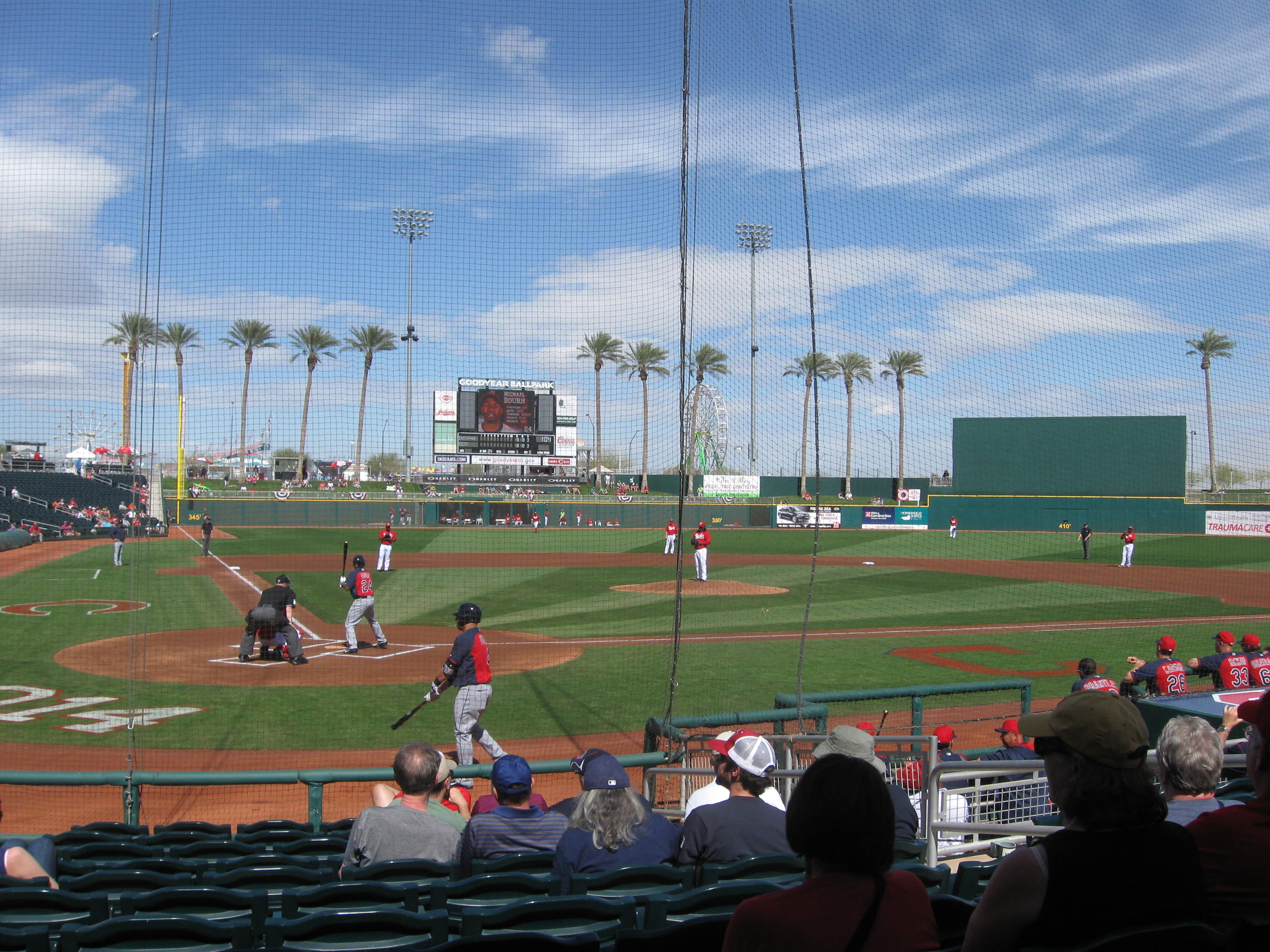
One of the best signs of spring - The Cleveland Indians spring training game in Goodyear, Arizona
One of the best signs of spring – The Cleveland Indians spring training game in Goodyear, Arizona

After years of thinking and planning, I achieved another of my baseball goals – I attended spring training. I chose to follow the Cleveland Indians to Goodyear, Arizona (a suburb on the southwest edge of the Phoenix metro area). I grew up a Cleveland Indians fan – I remember listening to games with my grandfather. I returned on Wednesday from Arizona, after attending three Cleveland Indians games and watching the team take infield and batting practice. I enjoyed the proximity to the players – you could hear the chatter when one of the infielders missed an easy grounder. I’m ready to go back.

Here’s a recount of my trip.

I flew into Phoenix, arriving the last Wednesday in February. On my way to the hotel, I visited the northern suburb of Cave Creek. I visited the Cave Creek Museum, which displays an old church used by the community, as well as a typical cabin used by tubercular patients who moved to the area. (It has wooden shutters that can open to allow a breeze to flow through.)

Thursday morning I drove to downtown Phoenix to tour the state capitol. The Arizona State Capitol is composed of several buildings. The historical capital is now the Old Capitol Museum and includes displays not only on the statewide officeholders, but many aspects of Arizona history. The Senate and House of Representatives have moved into their own separate office towers. I was able to view the chambers from the gallery. The entire complex is similar to Florida – an old state capitol (now museum) between legislative buildings and in front of a state government office tower.

From the State Capitol, I drove west to Goodyear, to the complex the Cleveland Indians share with the Cincinnati Reds. The Indians have nine fields (six of them full fields) surrounding a massive clubhouse. I arrived too late to see more than a few players taking additional batting practice. I made the 10-minute walk to Goodyear Ballpark, to watch my first spring training game. The Cincinnati Reds served as host to the Indians (a favor that was returned the following day). The ballpark’s design reflects that it was built in the middle of an open area. The stadium seats 10,000 or so (the size of many Triple-A facilities), but there is plenty of open space in the outfield corners. This open design allows for a whiffle ball diamond in the deep right field corner, out of the range of all but the strongest-hit foul balls. Vendors ringed the concourse. The ballpark was staffed by volunteers (mainly retirees) from both Arizona and elsewhere. (Is it too early for me to volunteer for 2035 spring training?) The Indians won the game against the Reds 12-3. The major league players started the game, but left after four or five innings. The rest of the game was played by minor league players and those veterans trying to earn a spot with a new team.

Friday morning I was one of the first two customers patronizing The Arizona Gentleman Barber Shop in Sun City. The barber shop is tucked into one of the multitude of shopping centers along busy streets, all of them low-profile with modest signage. The Arizona Gentleman Barber Shop has four chairs and three barbers were present when I arrived. The shop is decorated with sports pennants from major league teams and colleges. I talked baseball with Bill. We talked a little about the Dodgers, and about the spring training stadium used by the Arizona Diamondbacks and the new Cubs park in Mesa. When Bill confessed to being an incurable Cubs fan, I asked about the team’s pitching.

I managed to catch infield practice and batting practice before Friday’s game. After enjoying the banter and the chatter among the fans, I watched the Indians shut out the Reds 4-0.

It began to rain just after midnight Saturday in the Phoenix area. The weather system left about an inch of rain in most places. The local weather forecasters were covering the event as “winter weather” and were cautioning the locals about driving in it. It sounded similar to weather forecasters in NC warning residents about an inch of snow. I tried not to laugh derisively at them, as I know it rains too seldom in Phoenix for drivers to get much practice.

The rain did pause long enough at Surprise Stadium to allow the Kansas City Royals to play 6.5 innings against the San Diego Padres. The Royals were leading 7-3 with one out in the bottom of the seventh when the rains returned. The game was called almost immediately. Surprise Stadium felt cozier and more like a minor-league stadium, with the team clubhouses for the Royals and Texas Rangers located on the outfield corners. The main entry is in center field and there is no entry behind home plate. The first stadium I have seen without it.

After attending services at a church nearby, I watched a Sunday afternoon game at Goodyear Ballpark. The host Indians defeated the Seattle Mariners 6-3. I thought about attending additional games Monday and Tuesday (all spring training games in AZ start at 1:05pm). Instead, I decided to play tourist around Arizona.

Monday I visited the main campus of Arizona State University in Tempe. And then I drove down towards Tucson. Interstate 10 runs through large stretches of empty Arizona countryside, with occasional signs warning drivers to watch for blowing dust. In Tucson, I took Interstate 19, which is measured entirely in the metric system. (Good thing I paid attention in Mrs. Holloway’s fifth-grade math class.)

I visited the Titan Missile Museum in Sahuarita. The key attraction to the Museum is the ability to tour a decommissioned nuclear missile silo. It is the only site remaining of the Titan II missiles. We walked down the steps into launch control and we also saw the missile bay. It is a basic, utilitarian military construction, with a launch control that resembles those featured in TV shows.

Monday afternoon I spent in awe of the great saguaro cactus. I drove through Tucson Mountain County Park and later to Saguaro National Park, both featuring fields full of saguaro and other cacti. Fully mature saguaro are those with arms, and many are a century or two old. I did my best to learn about the majestic plant, indigenous to the Sonoran Desert (in Arizona, northern Mexico and eastern California).

Tuesday I drove to Wickenburg, once known as the Dude Ranch Capital of Arizona as the area contained many of the popular, early ranches. I visited the local Desert Caballeros Museum and walked around the rest of town. I also visited the McCormick-Stillman Railroad Park in Scottsdale. The Scottsdale Railroad Museum is located at the Park, and houses the Roald Amundsen railroad car used by FDR and three other presidents. I walked the length of the car (which was built to be self-contained with its own sleeping, dining, and entertainment quarters) and stood on the back platform, pretending I was FDR greeting voters on a whistle-stop 1940 campaign.

I spent most of Wednesday traveling home.

My 50-State Project Scorecard (with number of states in which I have done each):
States Visited (47) – Arizona
Haircut (38) – The Arizona Gentleman Barber Shop, Sun City
State Capitol (33)
Church (36) – Estrella Mountain Church, Goodyear
Movie (34) – Anchorman 2 at Harkins Arrowhead, Peoria
Barbecue (33) – Bryan’s Black Mountain Barbecue, Cave Creek
Baseball (29) – Spring Training, Goodyear and Surprise
Community College (36) – Scottsdale Community College “Fear the Artichokes”
Complete State Sets (24) – Arizona

A field of saguaro at Saguaro National Park, west of Tucson

The Barbershop – A Haircut in 100 Different Locations

The Barbershop in Thomasville, NC - 100 Different Places for a Haircut
The Barbershop in Thomasville, NC – 100 Different Places for a Haircut

Last Saturday I reached a milestone. I have now had a haircut in one hundred different places. The location? The Barbershop in Thomasville, NC. Thomasville is known as Chair City – Home of the World’s Largest Duncan Phyfe Chair. The experience was family-friendly, as entire families came to hang out even if only one was getting a haircut. The shop also has a flag hanging from the roof, the first time I have seen that.

Since February 2000, I have had haircuts in small towns across the United States. And Chicago, Denver, and Seattle. I have opted for the small-town or owner-operated affairs, although I will assume responsibility for using a national chain for a year in my early 20s. I once patronized a Southern beauty salon that could have fit in Steel Magnolias. And a beauty salon that prides itself on the latest hair fashions. I have had a haircut in a bar and on a military base. And in the basement of the old Student Union at Duke University. And between the wiper blades and the game room in a truck stop. And in a barber shop whose most recent calendar celebrates all the Presidents through President Bush (all 41 of them).

I enjoy the traditional (or old-fashioned, if you insist) barber shop experience. Climbing into the barber’s chair, getting the barber smock, and the tissue around the neck is largely the same in every shop. What differs is the barber and how the shop reflects the personality of its owner. Pictures of the family, of friends and businesses long gone, and of the owner’s hobbies: classic cars, musicians, sports teams and stadiums. Sometimes collections hang on the wall: old farm implements, running and hunting trophies, news clippings from an earlier day celebrating the shop or the town where it resides.

Conversations also depend on the barber. When the barber does not know you, you start by explaining how you found the shop and by answering biographical questions. Sometimes you can join in the already existing conversations. And sometimes you can even get your haircut in silence. In my experience, a good barber shop conversation requires only the two of you, although I have found it is better when the entire shop is involved. You need only to have an opinion or another question to keep the conversation going. In a barbershop, you are assumed to be a local, unless you say otherwise.

A traditional barber should ask you how you want it cut. If it is the first time you’ve been there. Or if you are in there every week. A man should have his neck shaved with a straight razor and shaving cream. And should instinctively cringe each time the clippers graze your ear. In my experience a good traditional haircut costs between $10 or $15, and you should leave a tip every time.

I have made an effort to patronize as many traditional barber shops as I can. They are a great way to experience the local community. And I enjoy the haircuts I have received thus far.

Barber Shop in Reidsville, NC